Antitrust Enforcement Can Deflate the AI Bubble Before the Public Pays
Sumit Sharma / Jul 7, 2026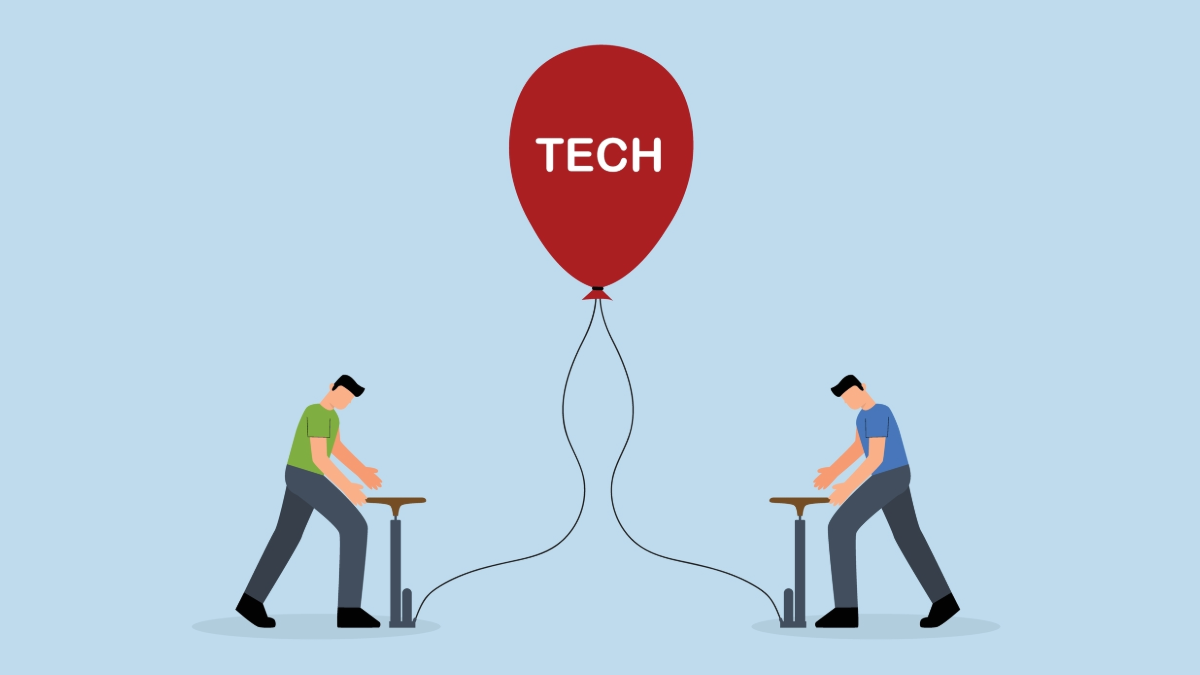
The AI bubble fomented by a few large technology companies is increasingly distorting large swaths of the global economy. It likely underpins the trillion-dollar IPO race between Open AI and Anthropic. Crossholdings among these large companies distort competition and risk turning a sectoral correction into a systemic one. If antitrust enforcement unravels these crossholdings, it may not prevent an AI bubble, but it could ensure that the inevitable correction prevents the failure of one firm from cascading across an interlocked network. Similar predictions apply in the utilities sector, where proposed mergers of electric utilities premised on uninhibited AI growth deserve critical review.
As evidence of the AI investor bubble, take Allbirds, a maker of sustainable wool sneakers that went public at a $4 billion valuation in 2021 and then lost roughly half its sales over the next four years. In April, the company sold off its footwear brand for $39 million, renamed itself ‘NewBird AI,’ cut a $50 million deal for GPU assets, and promised to become a GPU-as-a-Service" provider. The stock surged 350 percent in a single week.
The speculative nature of the AI economy is also behind the proposed $420 billion mega-merger between Dominion Energy and NextEra. Power costs in Virginia are up 12 percent since February 2025, and the press release announcing the merger touts “a more than 130-GW large-load pipeline,” reflecting speculative AI data center demand. Antitrust enforcers and state commissions need to ask what will happen if this demand fails to materialize and ensure that these risks are not borne by households across Virginia and the Carolinas by way of further increases in electricity prices. One way to do this would be to require a ring-fence separating the regulated utility business from the speculative AI data-center business.
As Hera Hyeonseo Lee explains, the potential trillion-dollar Anthropic and Open AI IPOs, an AI-rebrand pump in equities, and a utility megadeal premised on AI demand are consequences of an AI bubble driven by two financial loops. The first is a cloud-for-credit exchange in which hyperscalers like Microsoft, Google, and Amazon invest in AI companies like OpenAI and Anthropic, then book the labs' returning cloud spend as revenue. The second is mark-to-market accounting rules, which allow these companies to book unrealized gains on these equity stakes as net income. For example, Amazon's stake in Anthropic alone added $16.8B to its Q1 2026 earnings, and Alphabet reported roughly $28.7 billion in similar unrealized gains.
The "Magnificent Seven" tech stocks today comprise roughly 35% of the S&P 500, and AI-related capital expenditure accounted for more than 90 percent of U.S. GDP growth in the first half of 2025. A market correction responding to these circular funding schemes and inflated valuations could have parallels to previous financial crises. The effects are likely to cascade through index funds held by many 401(k)s, utility prices, and the federal balance sheet simultaneously.
Enforcing US antitrust laws would restore the competitive incentives that these crossholdings have dampened, and by requiring companies to unravel them, regulators would also help let the air out of the AI bubble. The playbook for bringing these cases is in the FTC’s January 2025 6(b) Staff Report on AI Partnerships and Investments. The report explains how cloud-for-equity binds the most promising frontier-model developers to the very firms they might otherwise displace, while making it harder for cloud entrants and independent labs to compete on the merits. These contractual terms and crossholdings simply create the appearance of competition while allowing consolidation.
The FTC’s reported scrutiny of Microsoft’s AI and cloud practices is a step in the right direction. Recent developments provide further evidence relevant to this case. OpenAI's restructuring into a Public Benefit Corporation means Microsoft owns roughly 27 percent of OpenAI Group PBC , a stake valued at $135 billion. Microsoft can also use OpenAI's IP through 2032, share in revenue payments through 2030, and Microsoft’s Azure gets first dibs on OpenAI products. Microsoft's own statement is unambiguous: it "continues to participate directly in OpenAI's growth as a major shareholder.”
The OpenAI-Musk trial also unsealed a trove of interesting documents. Internal emails surfaced at trial and reported in detail by The Verge show that Microsoft's leadership was not especially impressed by OpenAI's early technical work. CTO Kevin Scott was, in his own words, "highly skeptical of an imminent breakthrough in AGI," and other executives questioned whether OpenAI's research pace justified more capital. Microsoft invested anyway, with Scott explaining, "my worst case scenario is having them ditch Azure for AWS… bad-mouth, then land with some big new innovation that is shared with our competition." Documents and depositions highlighted by Vox further show Satya Nadella and other Microsoft executives weighing in on the composition of OpenAI's board during the November 2023 crisis that briefly ousted Altman, an uncommon governance intervention for a passive minority investor.
The 27 percent minority stake and new material explaining that a key motivation behind Microsoft’s investments in OpenAI was to build a moat to protect Microsoft’s cloud computing business are exactly the fact pattern that Guideline 11 on minority and partial acquisitions of the 2023 US Merger Guidelines covers. The use of board observers and executive interlocks to steer commercial decisions is also what the prohibition against interlocking directorates is intended to prevent, as the DOJ and FTC’s joint submission explains.
We need antitrust enforcement to ensure that AI firms compete independently and vigorously, without the contractual restraints of cloud-for-equity, without overlapping boards, and without minority stakes that quietly align incentives. The result will be greater innovation and a wider choice of independent and differentiated suppliers of this key technology for consumers, companies, and the government. It will also help ensure that these markets are structured so losses from risky AI bets are borne by the companies taking the risks as they should in a well-functioning market economy. Recent musings about the US Government taking a financial stake in leading AI companies are also antithetical to the market disciplining or rewarding for risk takers—the main engine of US economic growth to date. It would also further inflate the AI bubble, the very opposite of what is required.
Authors