An Indian Trans Person’s Harrowing Encounter Fuels Backlash Against Meta AI ‘Pervert Glasses’
Karen Rebelo / Jul 24, 2026Karen Rebelo is a Mumbai-based independent journalist whose work focuses on algorithmic accountability. Elements of this post were first published on Article 14 and Newslaundry.
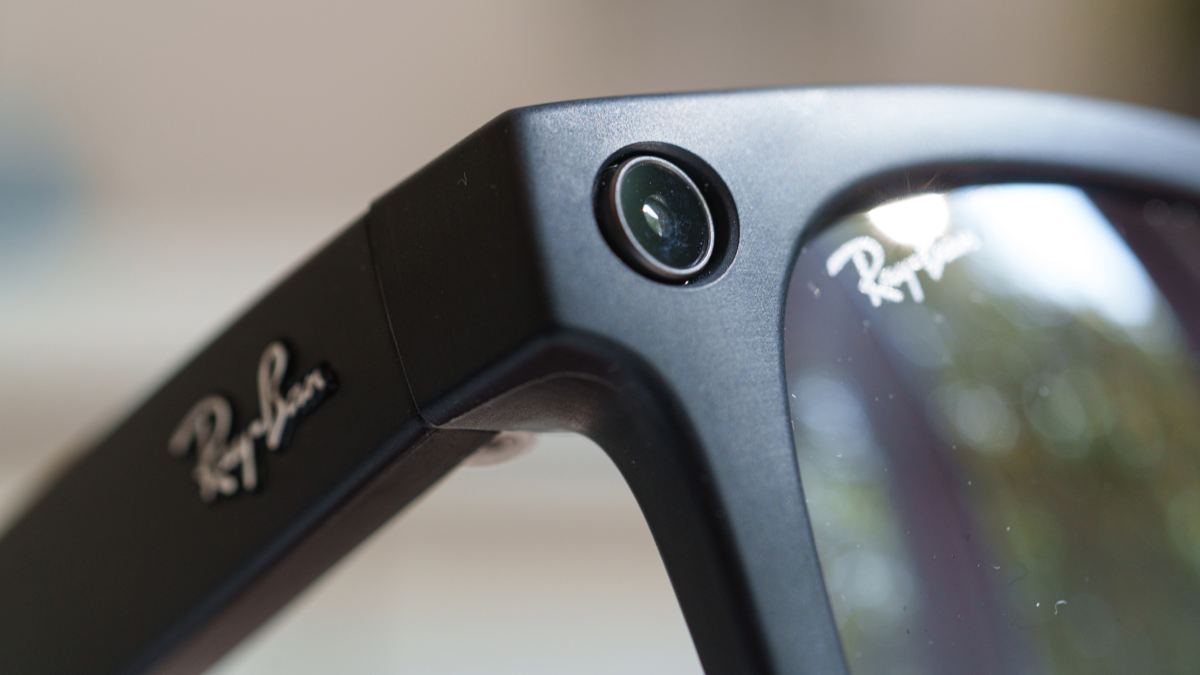
Close up of the Ray-Ban Meta Wayfarer camera integrated into the smart glasses frame. Shutterstock
A growing chorus of angry Instagram users in India are dubbing Meta’s artificial intelligence powered smart glasses “pervert glasses” as incidents of abuse caused by use of the company’s wearable tech crop up.
Meta enlisted cricketer Virat Kohli and a roster of content creators to promote its Gen 2 version of the glasses aimed at affluent Indians.
But the smart glasses—which enable wearers to take photos, videos, respond to voice commands along with other features—are increasingly at odds with privacy and consent, raising concerns about civil liberties.
In one of the most egregious instances of tech facilitated gender based violence, a trans person was recorded by a social media content creator wearing the Meta AI Ray Ban smart glasses at a trans rights protest.
Organizers of the protest had stationed volunteers to discourage filming as many participants were not out with their gender identity or sexual orientation.
In late May, three weeks after the protest, a content creator—who calls himself Parley—edited and uploaded the video to Instagram, unleashing a wave of transphobic hate and AI-powered memes.
Shubnam, who identifies as transfeminine, said they were in the middle of moving house when they found out that a video showing them rebuking Parley had gone viral.
“I was in the middle of shifting homes when this entire shit show went down,” Shubnam, who works as a graphic designer and artist, said. “I was packing a giant carton when I got a text about that video on May 26 and then it just kept growing,” they said.
Dressed in a green saree with a shorn head, Shubnam cut a striking figure at the protest on March 29 at Delhi’s Jantar Mantar grounds against the Transgender Persons (Protection of Rights) Amendment Bill, 2026. The bill was slammed by trans activists for being regressive but hastily passed by Indian lawmakers anyway.
In the aftermath, Shubnam posted their own selfie video explaining how their privacy was violated. They also uploaded an illustration calling the glasses “pervert glasses.”
“I'm being clocked everywhere now. Everyone recognizes me from the meme,” Shubnam said in an interview.
“The stares are now either painted with a smirk or angry intolerance. The reach of my own response video was obviously a fraction of the reach of the original unconsented reel,” they said.
Shubnam has spent the last few weeks being advised by a lawyer and working with Rati Foundation—a civil society organization—to get online copies of the video removed even as new posts keep cropping up.
A counsellor at Rati Foundation, whose work deals with online image abuse, said Shubnam’s case was not the only one involving smart glasses and described another instance where a content creator recorded his conversation on the street with college students. Although not obscene, they said the video was removed from platforms since it involved minors.
Meta first denied, then deleted
When Instagram users reported the video of Shubnam, they got an automated reply saying the clip did not violate Instagram’s Community Standards, apparently contradicting the platform’s guidelines on bullying and harassment.
As LGBTQIA+ groups in India kept up the pressure, Meta deleted the video three weeks later, but not before it had rewarded the content creator with notoriety through millions of views and thousands of comments.
In an email, a spokesperson for Meta said the glasses have an LED light to signal to other people that a recording is underway and that users were responsible for using them in a safe manner.
“Our terms of service clearly state that users are responsible for complying with all applicable laws and for using Ray-Ban Meta glasses in a safe, respectful manner,” the spokesperson said. “And as with any recording device, people shouldn't use them for engaging in harmful activities like harassment, infringing on privacy rights, or capturing sensitive information.”
Meta has partnered with eyewear brands Ray Ban and more recently Oakley to manufacture its smart glasses. The Gen 1 version starts at 22,400 rupees (about $232) whereas the latest Gen 2 version is upward of nearly 40,000 rupees.
Privacy experts point to Meta’s dual role as the developer of the wearable tech and as the distribution platform—Instagram in Shubnam’s case.
“Meta has full responsibility because it built both the camera and the platform. It designed glasses whose only warning to bystanders is a small light, and we have seen how that ends,” said Apar Gupta, founder director of the Delhi-based Internet Freedom Foundation (and a fellow at Tech Policy Press).
“The marketing around the Ray Ban Meta glasses does not make them a consumer assistive device when the core functionality ties to surveillance of human beings. It is downright profiteering without consent, and Meta is failing to account for civil liberties,” Gupta, who is also a Supreme Court lawyer, said.
Smart glasses as assistive tech
Away from voyeuristic misuse, a growing number of visually impaired content creators are finding utility in Meta’s smart glasses.
Twenty-year-old Ashka Goyal, who has no eyesight, is using the glasses to help her read labels and choose her outfits. She also uses the glasses to record videos for her budding Instagram page.
Goyal, who hails from the Indian city of Raipur, is living independently in the UK while pursuing a degree in fashion at the London College of Fashion.
A National Health Service-affiliated doctor recommended the smart glasses and got her to try them on during her visit to get a disability certificate in March. Goyal said the Meta AI smart glasses work far better and cost a fraction of the Orcam MyEye Pro glasses for which she forked out a whopping 450,000 rupees ($4665).
However, investigative journalist Julia Lindblom—who has uncovered privacy risks surrounding smart glasses—says despite its positive utility the glasses pose a privacy risk not just to bystanders but also to the wearer.
Different types of data belonging to the wearer are also constantly being logged, she explained.
Asking a question can initiate a recording
Lindblom, who works for Swedish outlet Göteborgs Posten, said simply asking the AI system a question can trigger a recording that can capture all kinds of data without the wearer or bystanders’ knowledge.
Lindblom previously reported how workers at Sama—a contractor for Meta in Nairobi, Kenya—encountered recordings from the glasses that included intimate visuals, such as nudity, sex, toilet visits and other sensitive information.
“The act of asking the AI a question can trigger the capture and transmission of audio, images or video, turning an apparently simple interaction into part of a much larger data-processing system,” Lindblom said.
AI systems can extract faces, voices, locations, relationships, objects, routines, documents on a desk and potentially sensitive information about health, religion, sexuality or immigration status, she said.
“The central issue is not only storage. It is what can be inferred, combined and reused,” Lindblom said.
“Most people focus on the visible camera: ‘Am I being filmed?’ But the more important question may be: ‘What happens after I am filmed,’” she said.
Smart glasses invisibilize human AI data workers
A group of people who rarely feature in the discussion around smart glasses and privacy are human data workers. Data workers, often belonging to Global South countries, annotate data captured through the glasses to make the wearable tech more accurate.
Lindblom explained that the rights of three groups of people should be considered when discussing privacy.
The first group are the smart glasses wearers who might not be aware when an AI request can cause images, audio, or other contextual information to leave the device.
The second group are bystanders who have no account or contractual relationship with Meta and usually have no opportunity to consent, object or request deletion. Yet their faces, voices, homes, workplaces, children or medical information may enter the system.
And the third group are data workers who might be required to examine disturbing and intimate material under work conditions they did not choose.
“The convenience experienced by a consumer in Europe or the United States can therefore depend on hidden labor and psychological risk elsewhere,” Lindblom said.
Authors