Amid Crackdown, Few Signs of a Slowdown in Scam Compounds
Laura Scherling / Aug 11, 2026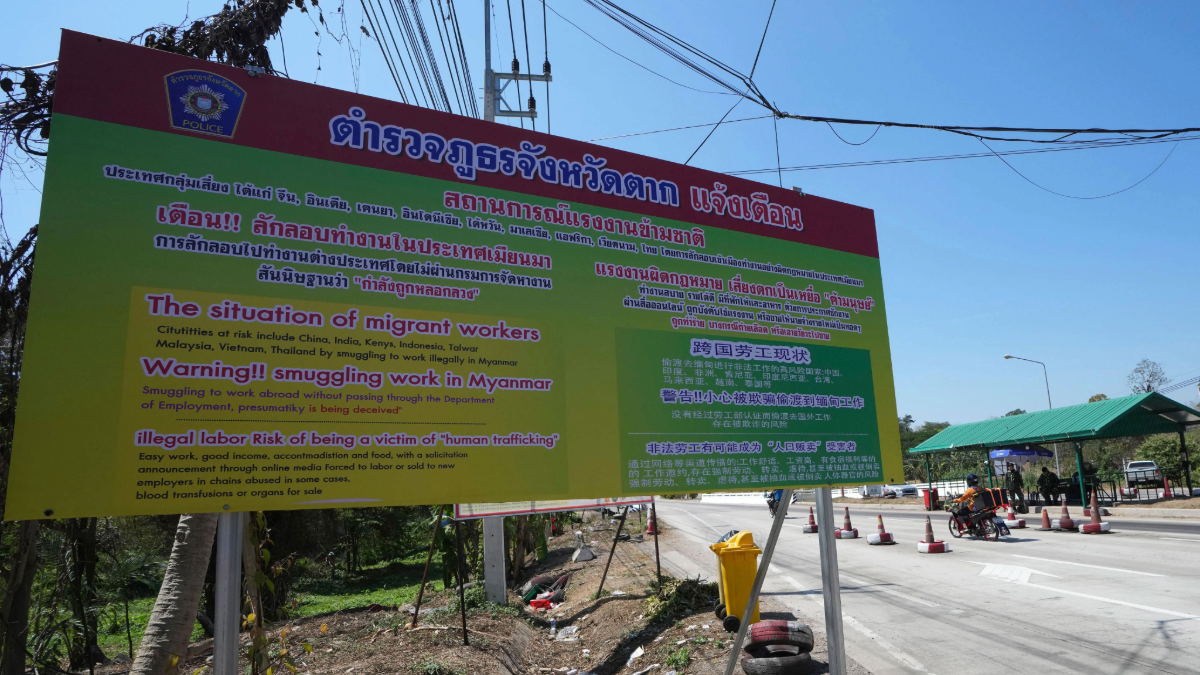
A sign near military checkpoint warns in Thai, English and Chinese of the danger of being trafficked and forced to work in locked scam compounds across the Myanmar border, in Mae Sot, Thailand, Wednesday, Feb. 26, 2025. (AP Photo/Sakchai Lalit)
The law enforcement crackdown on scam compounds across Southeast Asia continues, but there are few signs that illicit activities are slowing down. Scam compounds are typically run by organized criminal gangs engaged in fraudulent operations at industrial scale. Trafficked compound workers are forced to work “up to 19 hours” per day defrauding victims around the world through romance and cryptocurrency investment scams. They are imprisoned in overcrowded living conditions with inadequate food and medical care.
Mechelle Moore, CEO of the countertrafficking organization Global Alms, can see new scam compounds being constructed over the Thai border in Myanmar, even as newer compounds move further inland. Moore runs one of the few frontline non-profits aiding human trafficking survivors in the Northwest region of Thailand. Many of Moore’s clients are survivors of scam compounds. Global Alms supports the Thai government and runs an emergency response team, a 24/7 hotline for reporting cases of human trafficking and gender-based violence, an emergency shelter, and aftercare services. Nevertheless, Moore and other organizations combating scam compounds saw their US State department lifeline frozen last year, making it more difficult to fund their counter-trafficking operations.
“At first we were unsure of the magnitude of the problem,” Moore recalled during an interview. In 2022, Global Alms experienced a significant increase in male trafficking victims coming out of scam compounds. The organization’s services were once predominately geared toward women, but it has expanded its services to support men, women, and children. Victims have been recorded coming from “78 nations across the globe.” “The only region we really haven't had victims coming out of Myanmar is the Pacific Islands,” Moore relayed.
A 2026 Office of the United Nations High Commissioner for Human Rights (OHCHR) report stated that despite growing attention to scam compounds, they are “still in place,” and arguably more “intertwined within the political economies” of Southeast Asia. There are estimates that “hundreds of thousands of people are believed to be trapped in forced labor” in the region. A recent OHCHR estimate attested to “300,000 people originating from 66 countries” in the scam workforce.
Last October, the Myanmar junta reportedly shut down a major Myanmar scam compound called KK Park. However, The New York Times observed shortly after that experts concluded “the crackdown was performative.” Sandy Lin, a KK Park worker, told the Times that the “company” running the compound had already rented a new building in nearby Myawaddy and it planned to relocate workers who didn’t want to flee. Meanwhile, Association of Southeast Asian Nations (ASEAN) member states have announced enhanced “regional action” through anti-online scam working groups, and a 2025 Bangkok Digital Declaration promised coordination with banking authorities, “timely sharing of information” on cyber incident responses, and digital literacy initiatives to combat scams.
The US Department of Treasury’s Office of Foreign Assets (OFAC) placed sanctions on transnational criminal organizations, such as the Prince Holding Group, that invest in scam compounds and “front companies,” coordinating with the UK Foreign, Commonwealth and Development Office and Japan’s National Police Agency. In June 2026, OFAC extended its efforts to target Hu Xiaowei, Prince Group’s “second-in-command.” The European Council also placed restrictive measures against the Prince Group, the Democratic Karen Benevolent Army (DKBA) in Myanmar, and Jin Bei Group in Cambodia, along with other individuals who operate scam centers in Southeast Asia. In early 2026, the US Scam Center Strike Force deployed FBI agents to work with Thai authorities to review “thousands of mobile devices” seized from the shuttered Shunda scam compound in Myanmar. The Strike Force also conducted a “first-of-its-kind” seizure of a Telegram channel used to post fake recruiter jobs to traffic workers into Cambodian compounds.
Despite crackdowns and sanctions, transnational crime syndicates appear to either relocate or build new scam compounds elsewhere in the region. Typically, compounds are built in remote border regions and Special Economic Zones (SEZs), which make them difficult to permanently shut down, even as regional and global interventions are carried out. Australia’s ABC News reported that compounds are growing “exponentially” and newer ones are being moved away from “population centers” and being built to look like regular apartments, which are harder to detect. Jason Tower, the senior expert with Global Initiative Against Transnational Organized Crime (GI-TOC), told ABC News “Scamming 2.0” is moving further from the Thai border.
OHCHR has warned about “corruption” being “deeply entrenched in the context of these lucrative operations.” Criminal syndicates are allegedly benefiting from collusion with politicians and government officials that further enables regional scam operations. Scam compound victims told OHCHR they have seen compound operators paying money to officials, and that operators have also been notified about law enforcement raids “in advance.” Other observers speaking to the Thai news site The Irrawaddy noted they have not seen any scam “kingpins” detained in ongoing operations and believe that Myanmar’s raids on scam hubs are “aimed at misleading the international community” to think they are fighting the scam industry. GI-TOC has argued that less attention should be paid to the individual scams being carried out by a scam center, and more research is needed on the “ecosystem” that enables compounds to operate.
Another force multiplier is the recent adoption of AI tools within scam compounds. In interviews conducted with the Associated Press and C4ADS, it was revealed that scammers were able to incorporate the use of chatbots, smart translation services, and “AI powered monitoring tools” to “control a workforce of trafficking victims” by tracking their behaviors. Safeer Mohammed Koorimannil, a trafficking victim and former scam compound worker, relayed to the AP that he used AI models to increase the “speed and scale” to target victims. Rather than attack several victims at a time, Koorimannil “targeted some 50,000 victims” in a month.
Moore, who has served as CEO of Global Alms for over a decade, says it is a myth that only low-income people are trafficked. She described working with trafficking victims who have “university degrees, masters [...] and a few that have had doctorates.” One of Global Alms’ youngest trafficking victims was around fourteen years old, and one of the oldest was 54 years old. On the receiving end of a scam, Moore also pointed out that “everybody has the ability to be scammed, it’s just a matter of the perfect script.”
With no immediate signs that the scam industry will slow down in Southeast Asia or beyond, OHCHR continues to press for a “human rights-based response to trafficking” that includes much more robust prevention measures than what currently exists. The OHCHR also sees a greater need for regional cooperation between digital platforms, financial institutions, law enforcement agencies, and civil society actors. Without a more coordinated effort, trafficked workers who carry out fraud and the victims being defrauded will continue to suffer in a destructive cycle of abuse.
Authors