AI, Surveillance and the Siege of Minneapolis
Justin Hendrix / Feb 5, 2026The Tech Policy Press podcast is available via your favorite podcast service.
"Operation Metro Surge"—the massive immigration enforcement operation playing out right now in Minnesota—was billed as a targeted effort to apprehend undocumented immigrants. But what it has exposed goes far beyond immigration enforcement. It has pulled back the curtain on a sprawling surveillance apparatus that incorporates artificial intelligence, facial recognition, and other novel tools—not just to enable the raids that have turned violent and, in some cases, deadly; but also to silence dissent, to intimidate entire communities, and to discourage people from even watching what masked federal agents are doing in their own neighborhoods.
To discuss these events and the prospects for reform, I spoke to Irna Landrum, a senior campaigner at Kairos Fellowship and author of a recent piece on Tech Policy Press, "How ICE Uses AI to Automate Authoritarianism," and Alejandra Montoya-Boyer, vice president for the Center for Civil Rights and Technology at the Leadership Conference on Civil and Human Rights, which has called for reforms at the Department of Homeland Security and its component agencies.
What follows is a lightly edited transcript of the discussion.
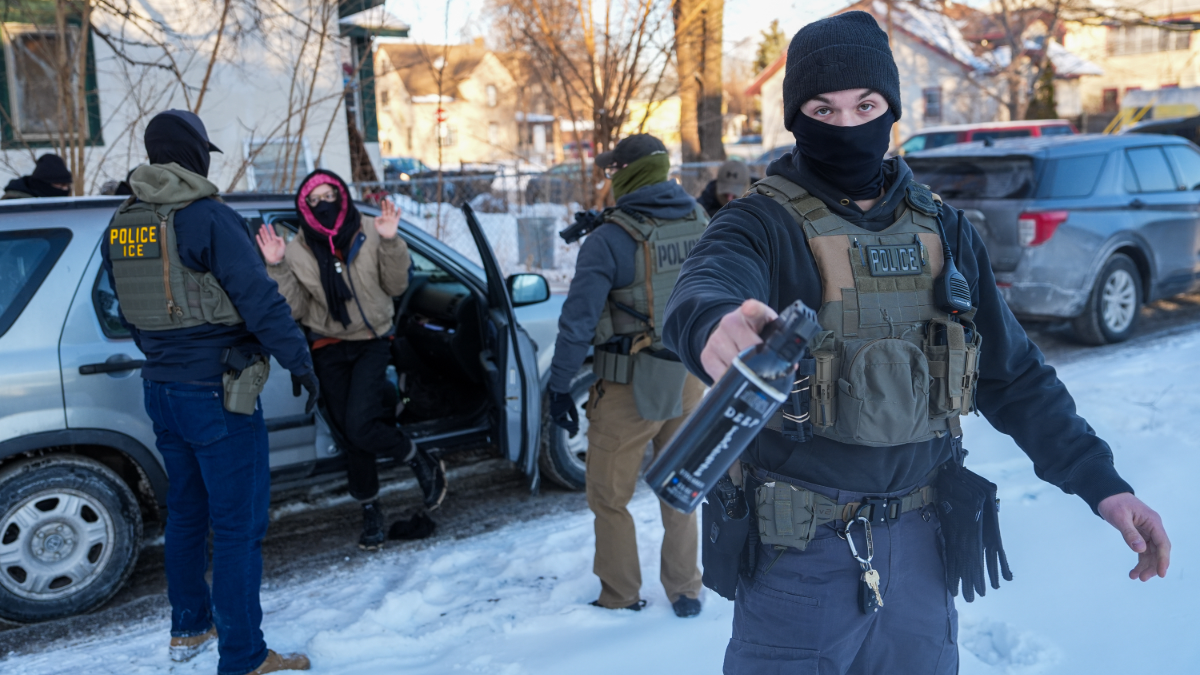
Activists are approached by federal agents for following agent vehicles, on Tuesday, Feb. 3, 2026, in Minneapolis. (AP Photo/Ryan Murphy)
Justin Hendrix:
Good morning. I'm Justin Hendrix, editor of Tech Policy Press. We publish news, analysis, and perspectives on issues at the intersection of tech and democracy. Operation Metro Surge, the massive immigration enforcement operation playing out right now in Minnesota, was billed as a targeted effort to apprehend undocumented immigrants. But what it has exposed goes far beyond immigration enforcement. It's pulled back the curtain on a sprawling surveillance apparatus, one that incorporates artificial intelligence, facial recognition, and other novel tools that isn't just enabling raids that have turned violent, and in some cases deadly, but is being used to silence dissent, to intimidate entire communities, and to discourage people from even watching what masked federal agents are doing in their own neighborhoods.
Yesterday, at a hearing before the House Judiciary Committee, Deepinder Mayell, the executive director of the ACLU of Minnesota, told lawmakers plainly that Minneapolis feels like a city under siege.
Deepinder Mayell:
... under siege, and where the First Amendment rights that we all cherish are under attack in a more grave way than I have ever experienced in my life. If you have not been on the ground in Minnesota in recent weeks, it is hard to imagine how un-American it has felt, and I want to give you a firsthand account.
For the people in Minnesota, this is a time of profound grief, fear, and outrage. In recent weeks, we have experienced violence, chaos, and abuse at the hands of hundreds and now thousands of mass law enforcement agents brandishing weapons of war on American streets. Two people have been shot and killed for observing and protesting the actions of federal agents, Renee Good and Alex Pretti. Witnesses to their deaths are their neighbors and fellow Minnesotans. One witness to Mr. Pretty's killing submitted a sworn statement to court in our lawsuit, Tincher v. Noem, saying that they were so afraid of retaliation, they went into hiding.
"I do not feel safe in my city," said another witness to Mr. Pretti's death. This person was a doctor who had run to the scene to perform CPR on him. "I worry that I or someone I love will be shot and killed for voicing their displeasure and being in the wrong place at the wrong time." This is not the America we recognize this is not the America and the free country that we cherish. It is not the America we deserve, nor the one that our laws or Constitution allow.
Justin Hendrix:
Now, you might think the scrutiny following the killing of Alex Pretti, a US citizen shot dead by federal agents, has forced the meaningful drawdown. White House border czar Tom Homan announced a reduction of 700 agents in Minnesota, but that's a drop from 3000 to 2300. That is still an enormous number of federal law enforcement in one metropolitan area, and the raids are not stopping. They're spreading into Minneapolis suburbs, where at least 12 communities have now formed a coalition in response to ongoing ICE operations.
Now, there are calls for reform. Democratic leaders Hakeem Jeffries (D-NY) and Chuck Schumer (D-NY) sent a letter to Speaker Johnson (R-LA) and Majority Leader Thune (R-SD) this week, laying out 10 proposed guardrails on immigration enforcement, things like requiring judicial warrants, banning masks on agents, mandating body cameras, and protecting sensitive locations like schools and churches. But the letter does not call for any substantial reform to the surveillance infrastructure itself, the AI tools, the facial recognition systems, the underlying architecture that makes all of this possible.
The one exception is a narrow demand for a prohibition on databases tracking people who participate in First Amendment activities. In this episode, we're going to dig into all of this, what's happening in Minnesota, the technology behind it, and where the policy conversation is and isn't going with two women who have been following these events and their implications closely, including on the ground in Minneapolis, and in Washington DC.
Let's jump right in.
Irna Landrum:
This is Irna Landrum. I am the senior campaigner at Kairos Fellowship.
Alejandra Montoya-Boyer:
I'm Alejandra Montoya-Boyer, and I'm the vice president for the Center for Civil Rights and Technology at the Leadership Conference on Civil and Human Rights.
Justin Hendrix:
I'm grateful to both of you joining me today. We're going to talk a little bit about what's going on, of course, in the Minneapolis area, and also what it tells us more broadly about some of the questions that I know both of you are concerned about, questions around artificial intelligence, and its role in surveillance and impact on civil rights.
But Irna, I want to start with you, of course, because you are there, on the ground in Minneapolis. We've been seeing so many images, video, of course, reporting. Pleas, in fact, come across my social media networks over the last few weeks as the situation there has unfolded. And, to some extent, there's a sort of sense outside of Minneapolis that maybe things calms down somehow in the days after the murder of Alex Pretti, but just today I'm seeing video of violent ICE stops occurring on those chilly streets.
Can you tell us what's happening around you at the moment?
Irna Landrum:
Well, yeah. I mean, what's happening around me is someone made a map of the murders of Alex Pretti, Renee Good, and George Floyd Square, and that's basically my wife's route from work to home. And so that's happening around me. But yeah, there's this sense of things having calmed down, but I know here locally, we're aware that some of Operation Metro Surge has moved into surrounding suburbs.
There's significant immigrant populations in suburbs like Brooklyn Center, a little more violence in St. Paul, and some of the active and vibrant immigrant communities there. And also still here, if we take dissidents not being gunned down in the street as calming down, then certainly things have calmed down, but ICE is still active, Border Patrol is active, and not only are they going after undocumented immigrants, but really the notion of the way that our neighbors are showing up, showing up to monitor detentions, to observe ICE as they're brutalizing our neighbors, they are feeling surveilled in a really uncomfortable way, and also retaliating in different ways.
I just saw a post from someone who I'm hesitant to name, because I don't want to get them targeted, but who's saying that now we have federal agents who are driving around honking their horns, because that's one of the signals that something's happening and come observe, they're honking their horns, and then as observers come out, recording them with their cell phones, recording them and taking pictures of them. So for me, I guess it depends on what you consider quieting down, but we are still dealing with a lot here.
Justin Hendrix:
Just to press you a moment on your experience in particular of things that you observe, the things that you are looking for, the kind of mediated aspect of this, the technology piece of it, give us a sense of what that's like when those agents are driving around, or in the street, phones out. What's that like in place?
Irna Landrum:
It's a clear indicator of the pressure that they're feeling, of the resentment that these federal agents feel around being watched, despite all of the technology available at their hands to watch us. They want to get our faces and names recorded. So I mean, they're feeling resentment around being observed and being surveilled in a way by our community, despite all of the tools in their hands to do the same.
And they do that with masks on, and they do that with the force of the federal government behind them. It creates a sense of them trying to intimidate, trying to intimidate neighbors away from protecting each other, from doing anything at all to get them to not violate our constitutional rights. It's clear intimidation. It's clearly meant to chill just the support and the growing solidarity in the Twin Cities, but that's not working. What I see is people, even more people stepping up to get trained, to be an observer, more people stepping into mutual aid networks and trying to figure out how to support people who are sheltering in place because they're afraid of being abducted.
And I see more people speaking out, people who are protesting, or going to rallies for the first time, communities creating art. There's been these ICE luminaries that have been created as a part of a regular winter festival, but a lot of them in honor and in memory of Alex Pretti and Renee Good, just showing the heart of this community towards not only our immigrant neighbors, but to everyone who has the courage to stand for them. They're trying to chill us, but this is a cold place. We're not bothered.
Justin Hendrix:
Alejandra, I want to bring you in, and I welcome you back to the podcast. You came here to talk a couple years ago about the urgency to bring civil rights into the conversation around AI policy. You've been studying these issues for some time, including both immigrant surveillance, surveillance more broadly, the DOGE phenomena, and the kind of breaking down of silos across the federal government that's been part of building these data lakes that we now see ICE taking advantage of, the use of drones, so many other things. You made a lot of warnings over the last few years, a lot of recommendations. How are you feeling about what you're observing in Minneapolis and beyond?
Alejandra Montoya-Boyer:
Thank you, Justin. First, Irna, thank you for sharing more about what's going on in Minneapolis directly. Being in Washington DC, we're obviously tracking all of these things, reading the news, but hearing about it directly and the way that it's impacting communities there is just, to your point, I think there's something really powerful and beautiful about the communities that come together in response, and just wanted to share my gratitude for that.
Yeah, we have been at the center and in the ecosystem and civil rights, at the intersection of civil rights and technology, have been ringing the alarm on these issues for ... I mean, before AI was even talked about in the way that it is now, we've been talking about this honestly for decades. These issues at the heart of civil rights and technology have been growing for years. We know that privacy protections were born out of fighting back against the fact that Black civil rights activists were surveilled in the '50s and '60s, built off decades of the use of surveillance against communities of color.
Post-9/11, we saw similar tactics against Muslim and other communities that were deemed a threat. So this isn't new. And to your point, we've been screaming warnings. So I think for us, there's a sense of ... Yeah, I hear people talk about, "We couldn't have predicted this, or no one would've known." We knew, we screamed at y'all about it for some time, both directly, the way that this has happened over time, whether it's normalizing the kind of anti-immigrant rhetoric that we've heard from this administration for a decade, but how these technologies play into that.
So Irna was talking about the fact that these agents are wearing masks. They are wearing masks very intentionally, knowing that they need to cover their faces because they have the technologies, the facial recognition technology, to be able to surveil, and track, and collect that data into databases. So there are very intentional practices that have been built up over years, that the civil rights community has been really targeting policymakers on the federal side, at the state and local side, really trying to say, "These are warnings for what we know is going to happen. These technologies can and are being weaponized against us."
And it's challenging for us to go from, facial recognition technology has been abused by local law enforcements to make false arrests in Detroit, in the South. There's story after story of people that we have been talking about, that's made ... New York Times has covered all these national news.
And then we're seeing it now in this new light, getting a different type of attention because it's on a mass scale. We're seeing the way that this is playing out. We've made the jump from this technology is not just being weaponized against immigrants, Black communities, other communities of color and marginalized people, but now it's at the threat of white communities as well, that people that are standing up, that are trying to protect their neighbors, that are calling out what is a political difference. Journalists are being targeted in ways that we used to only kind of normalize for people of color and other marginalized people.
Justin Hendrix:
Irna, I want to give you a chance to also kind of bring in your perspective as a researcher, as somebody who studies and campaigns on these issues. I mean, one thing I'm struck by listening to Alejandra there is that this is a long timeline. And we could look back as far as, as she says, the '50, '60s, we could certainly look back to the step change after 9/11.
But one thing I find myself thinking about a lot these days is that this is a bipartisan kind of expansion of surveillance capability and investment. It's been decades of both parties investing in these tools and technologies and effectively both sides sort of saying, "When we're in office, we are responsible stewards of this power. We will use these tools in a humane way." What can you say about that from your vantage there in Minneapolis?
Irna Landrum:
I think what I can say is, I mean, honestly, I'm thinking about when Kamala Harris was on the campaign trail, talking about using AI to build the most lethal military force on the planet. And I mean, that's dangerous. And any technology that we build to other, harm, repress, annihilate other people can always circle back around and be used to do the same to us.
And so that sort of bipartisan bloodlust that we sometimes feel around enemy nations, or even domestically, that we feel around people who are labeled criminals, is something that is now coming back to bite people who imagine themselves law-abiding, upstanding citizens, because really, the idea of who's a criminal, and who deserves surveillance, and who must be monitored changes depending on who is in charge. And so now we're hearing that this is criminal interference with federal operations, to stand and record someone, when we know that that's a First Amendment right.
We're hearing that it is a federal crime to protest at a church, although it has not been criminal or morally bankrupt to storm churches and abduct our undocumented immigrant neighbors. And so when we start talking about building tools that automate our ability to monitor, track, surveil, and keep track of any group of people, we have to know that at some point we're going to be in line and it's going to happen to us.
And I hear a lot from people, especially here in Minneapolis, where we had the 2020 uprising after police murder of George Floyd, where we had communities coming together after the murder of Philando Castile, where our community came together after the police murder of Jamar Clark in 2015. We have been saying that all of these different arms of policing that are being used against Black communities here in Minneapolis are wrong.
And I'm hearing a lot of anger and grief around, Alejandra, what you were saying, about now that it is targeting white people, now that it is targeting folks that in rhetoric haven't been just deemed criminal for existing, there's a lot more fire around people. And I hope that this moment is a tipping point, that there isn't a moment where it feels calm enough for people to not be concerned about who we're monitoring and who we're pointing suspicious eyes towards.
Justin Hendrix:
Alejandra, I want to ask you about that. In a way, I feel like you go back to 2024, and some of the recommendations you were making then, the window has shifted, right? We're in a very different place. It's not clear when the policy opportunity will arise again, although we are seeing some moves in Congress right now to try to, at least, place some limitations on spending, and maybe do some other oversight in that, even in a Republican-controlled Congress, there seems to be a little bit of motion towards that. But with this window opening up, perhaps in future, based on some of the foment that Irna's talking about, I don't know, what can you imagine? What should the policy demands be?
Alejandra Montoya-Boyer:
I mean, I think there is the near term, the direct response to the tremendous amount of money and power that DHS, and particularly ICE and CBP have right now. So there's the immediate need to stop any new additional funds from going to ICE or CBP. We are in active support of being able to actually rescind funds. That money was redirected to DHS from social service programs like education and childcare and housing, and that money deserves to go back into our communities, not to be buying up technology and surveillance tools and building databases that are weaponized against us.
So first and foremost, there's kind of like the funding and appropriations piece, but with that, there's also a drastic need for restrictions on these technologies. No administration should have this type of power. This is not about Democratic president versus Republican president. These technologies need to be restricted no matter who is in office.
And so that means that we are making sure that DHS, ICE cannot exploit the data that the government holds, whether that's Social Security, healthcare, IRS, any data that someone is turning over with the expectation that they're getting public services, they're participating, they're doing the right thing by paying their taxes, that data is only used for its specific purposes, and that does not include federal law enforcement, immigration enforcement.
So restrictions on the data that DOGE stole last year, limiting the acquisition and procurement of surveillance technologies, that includes prohibitions on biometric and particularly dragnet technologies that do mass surveillance. That includes making sure that we're limiting the way that not just the technologies themselves, but who and how they're procured from, to make sure that these technologies and the companies that we're getting these technologies from have proper assessments, audits, there's transparency across the board, really making sure that there are these types of restrictions in place always.
And transparency and privacy protections are at the heart of this, things that we've been calling for forever and really build out kind of the ... If these are the near term asks, the longer term need is comprehensive federal privacy-protecting AI guardrails. We have a massive industry that has blown up over the past five years, and it will continue to do so. And regardless of whether these technologies are being put to good use, to benefit our economic opportunities, to increase educational opportunities, there still needs to be guardrails that make sure these technologies are free from bias, that we're mitigating the harm that they have, that we're ensuring a workforce that has training and equal access to these types of technologies.
So while this moment, so to say, is opening the door for conversations specifically around surveillance technologies and the way that federal enforcement or federal law enforcement are using and accessing these technologies, we're also at a time where there is a broader conversation about what AI technologies, the role that they play in our society. They're here, the likelihood that we're going to be able to roll them back or have these prohibitions or bans on these technologies is very slim, but what is necessary and is feasible, is realistic, is federal comprehensive guardrails that make sure that these technologies work for everybody, that innovation includes safety, equity, and all of these pieces kind of come together to make sure that these technologies are not weaponized against us, and better, they allow for benefits for all of us.
Justin Hendrix:
I'm seeing a set of voices, including Ben Rhodes in the New York Times, in an op-ed over the weekend, sort of saying, "Hey, it's been 25 years since 9/11. We've created a monster in the DHS, and maybe it's time to more substantially take this thing apart." And of course, many of the folks on the street in Minneapolis, and all over the country in the protests that we're seeing have that singular demand, to abolish ICE. I think many would now include seeking significant reform to CBP, to DHS more broadly. Do you feel that there's that kind of energy where you're at, to begin to look to maybe more substantial reform to these entities?
Irna Landrum:
So I'd say, yeah, there's differing levels of hunger for reform to happen inside these entities. I've heard calls as strong as abolish ICE, and I've heard calls somewhere around don't give DHS any more money without significant reforms. But then some of the reforms that people suggest, like more training, and the lack of training isn't the point. Don't really get to the heart of what's happening. And some of the other reforms being named, like making sure that they wear body-worn cameras. Well, we have multiple angles of all of their abuses from several cell phone videos, but also, that's looking to give more money to these repressive agencies so that they have more toys to look at.
And we've seen here in Minneapolis and across the nation, body cameras do very little when people turn them off when they want to. And they do very little when there aren't really clear guardrails and guidelines around who gets to view them, and who gets to use them, and who gets to edit them.
And so yes, I would say, very, very differing degrees of desire for reforming these agencies, right on up to abolition. And I think for me, and I speak only for myself right now, I think if we start to look at the people in our community who have less than us, who maybe need more government support, who have fled to our communities because of the support that's available, we start looking at need as just a fact and not something that means another person is trying to steal from you, or that it is criminal to need, then we could really get to the heart of what reforming government agencies even is.
But right now there's so much, the rhetoric is so divisive, and so, like, us, them, enemies, allies. And I want to make clear that I'm not bot-sidesing this in any way. There's a repressive regime in our communities, and it needs to be dealt with in very strong ways, including not ... I remember when we were realizing that DOGE had 19-year-olds in the government with full access to all of the information, like non-anonymized data about each and every single one of us, our voting records, our health information, our Social Security Administration, our tax information, and all of that now is available together with just huge, huge classes of information about all of us.
And there's never a need for that. And in crisis moments like 9/11, when we decide that there's an exemption around humanity, and we have to go forego our privacies and protections, then yeah, we end up here. We end up here, where it's out of control, because the line keeps getting moved further and further and further back.
Justin Hendrix:
It feels like we really are at an extraordinary inflection. Not only are we seeing these things happening on the streets, we just had, of course, the passage of the Big Beautiful Bill. And I know that the funding is being contested, but that was to add billions of dollars more, not only for immigration enforcement, but for surveillance technologies. We just saw the DHS AI inventory come out, and that shows, of course, a huge increase in the number of tools, and significant new capacity with regard to things like facial recognition and biometric scanning, and all manner of AI tools. I don't know, Alejandra, can you imagine a world where two years from now, three years from now, five years from now, the surveillance state is smaller, or somehow less-equipped than it is today? Is that a political possibility in this country?
Alejandra Montoya-Boyer:
The reality is, these technologies have been built, they exist, they're in people's hands. And throughout history, we have seen it is very difficult to roll that back once it's out. Once the technology, the weaponry exists, yeah, it just becomes much harder.
With that being said, we have a huge opportunity. The public is calling for prohibitions and regulations on AI. People are, I mean, in the streets responding to support, showing up to support their neighbors, their family members, all of the things in ways that ... It goes to show that if there is enough pressure and movement, people are going to stand up in the face of a massively oppressive surveillance system that is actively tracking them. I mean, they're using Mobile Fortify to scan people's faces and put that image into databases, whether it's protestors, or legal observers, or journalists, or undocumented people, there is a response.
And so for me, there is something to be said about the political will shifting because people are not willing to allow this to be the state of our democracy anymore. We are going to ensure that, whether it's advocacy on the Hill, talking directly to Congress members, whether it's engaging with state legislators, it's attending protests, all of the different ways that people make their voices heard, engaging with the private sector. Tech companies have a huge responsibility in this. We're seeing people changing the way that they participate with some technologies, voting with their money, with their dollars in response to these things. And so all of that to me, in my moments of hope and optimism, show that yes, we will have the political will to be able to at least put guardrails to ensure that these technologies do not take over to create a massive surveillance state, the direction that we're heading right now.
I think that will take a tremendous amount of groundwork, whether in place, on the hill, in all of these spaces to make that a legislative reality. But that being said, that message is getting heard. I talk to members on the Hill and they know that they're feeling that pressure. They're getting called left and right, they're getting email ... Like all of the ways, and that pressure is building and building, and it is a tremendous tragedy that it takes people dying in the streets and people that look a very specific way dying for it to get this attention, but the attention is there. And I think we as advocates need to use this, and excuse me, I'm not saying to use tragedy, but there are moments where we can push in a very specific way for the policy changes that we need, and I think this is one of them.
Justin Hendrix:
One of the other areas that we're watching closely is what Washington Post keeps calling the rebellion against data centers. It's hard for me sometimes to look at the phenomena we're observing around ICE and CBP, and this domestic surveillance panopticon that we're slowly building, as you describe, Irna, and then also look at these giant concrete squares that are being built in communities across the country, and not see a kind of dystopian kind of picture emerging here.
And it feels like to me that a lot of the resistance to data centers so far has been around environmental concerns, around electricity, energy, and only in some communities has there been a real connection made to these broader questions around authoritarianism, centralization of power, what exactly is going on with the data that's coursing through those things. But do you think there's an opportunity now to draw those narratives together and make that connection?
Irna Landrum:
Oh, absolutely. I was thinking about your earlier question of if it's possible for the surveillance state to be smaller than it is now. And one thing I wanted to say about that was, I think as long as we never lose sight of the fact that what's happening right now is very, very visible, but what's happening right now is also happening in some communities somewhere every day, whether there's a cell phone video of it that goes viral on the internet every day.
And a lot of this relies on our willingness to comply in advance, to submit to scans, and pictures, and heavy surveillance without questioning it. Which I thought about my wife and I have a bit of an age difference, and she doesn't remember going into the airport without all of this national security theater. And so I think for those of us who do remember, and have a lot of resistance to just submitting to things that feel like a violation of privacy just because someone asked us, we can put forth this moment, where people are feeling deeply violated just across the board, and make sure that once the pressure is off us, once there's a different president in the White House, once we feel like we're breathing a bit more, that we don't let our foot off the gas.
So I wanted to say that. But with respect to data centers, absolutely there's a through line. Because this surveillance operation absolutely relies on cloud storage, and the massive amounts of compute that are available with hyperscale data centers, that are popping up not only across the country, but around the world. And I think when people think about the cloud, like, well, what's a cloud? It's such an amorphous idea. But our data, our photos, our information, it all lives somewhere. And where it lives is in these hyperscale data centers.
And if we really take the time, and bring the cloud to the ground, and look at this infrastructure as something that it needs, then we can starve the surveillance state of the infrastructure that it needs in order to operate. And so I think we would be missing a great opportunity if we didn't connect these dots, because it's not a leap.
If we didn't connect the dots between the massive amount of computational power that's needed, the mass amount of storage and cloud services that are needed, and the massive amounts of money, billions and trillions of dollars that, as you said, Alejandra, could be going into supporting our communities. People are getting obscenely wealthy from surveilling us. And if we don't tie those different stories together, then we're missing a massive opportunity to really shrink the surveillance state and invest into real support for our communities.
Alejandra Montoya-Boyer:
I think there's really something to be said about the ... I'm not one who always wants to talk about the economic impact, and that's where it connects, but that is where people ... I mean, people, voters and people are experiencing their life through an affordability crisis right now. And the conversation connecting the dots between our taxpayer money that has been stolen to fund a surveillance system working against us, coupled with the rise in electricity costs in places where data centers are being built, the use and abuse of our natural resources against us, there are so many ways in which all of these things coupled together, not only are people getting massively wealthy off of that at the expense of everyday people, there are conversations that we can be having that are really connecting those dots, that are showing, this is not just about tech companies wanting all of our data and all of these things for no reason.
This is an economic crisis, and we can do better in the way that we communicate and talk about these issues so that it doesn't feel ... AI and tech policy can feel very wonky, and very in the weeds, and talking about biometric data collection and blah, blah, blah. But at the end of the day, what we're talking about is we are footing the bill for this government to get very rich off of our ... I mean, not just our money, our data and natural resources in ways that I think resonate with people to build back that political power that you're looking for, Justin.
Irna Landrum:
People often talk about data centers, as you said, and their environmental impact. But something that gets lost, I think, in environmental impact is that people who live around environmental impact also often suffer a lot of chronic illness. And here in some of these communities, we have elevated rates of lead poisoning and asthma. And there's just so much additional harm to our everyday communities in order to stuff the pockets of people with our money. I really appreciate you saying it that way, Alejandra, with our money, to do harm to us.
Justin Hendrix:
I think we'll leave it there. I want to thank the both of you for taking the time to speak to me. Irna, Alejandra, I wish you the best. And Irna in particular, hope you're able to find little peace in the chaos that's been around you these last few weeks.
Irna Landrum:
Thank you.
Alejandra Montoya-Boyer:
Thank you, Justin.
Authors