AI Hype Helped Google Dodge an Antitrust Breakup. What Comes Next?
Justin Hendrix / Oct 20, 2026Audio of this conversation is available via your favorite podcast service.
Google is an illegal monopolist. That is the finding of two federal judges in landmark antitrust cases over the company’s dominance of online search and advertising technology. But when it came time to order remedies, neither judge broke up the company.
To discuss what the remedies mean for competition and what they portend for the broader effort to hold big tech firms accountable to democracy, particularly in the AI era, I spoke with Barry Lynn, executive director of the Open Markets Institute, and Mihir Kshirsagar, who leads the Tech Policy Clinic at Princeton’s Center for Information Technology Policy (CITP).
What follows is a lightly edited transcript of the discussion.
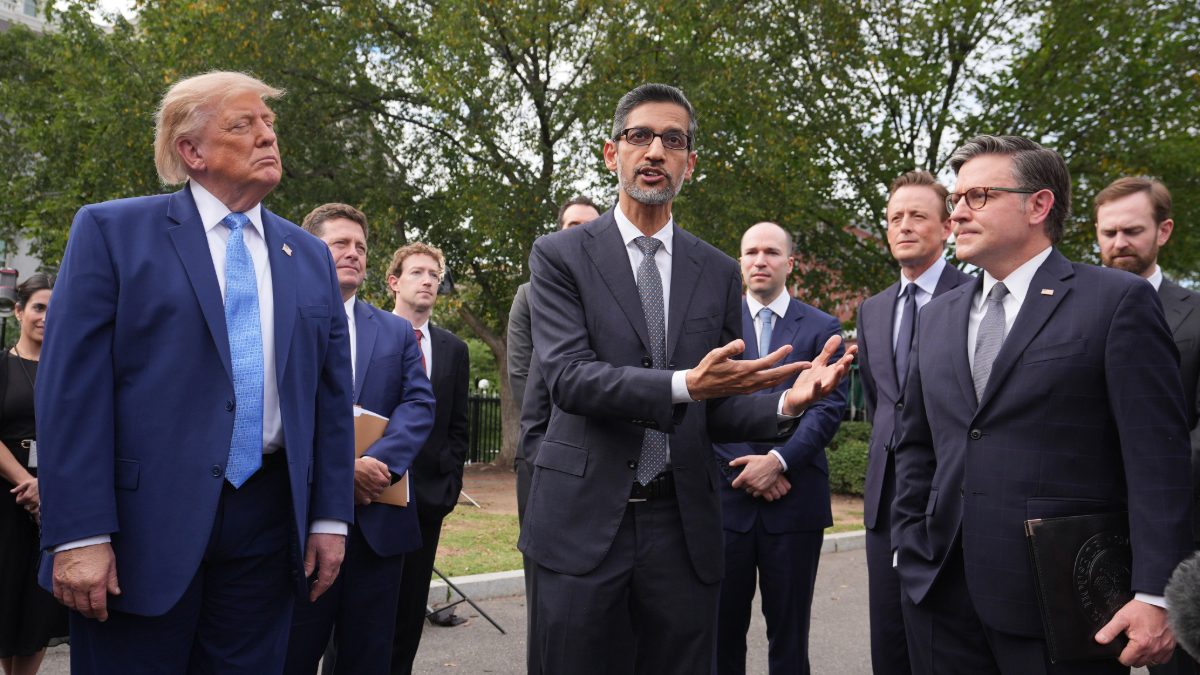
President Donald Trump and House Speaker Mike Johnson of La., listen as Google CEO Sundar Pichai speaks to reporters at the White House in Washington, Tuesday Sept. 29, 2026, after meeting with top executives of AI firms. (AP Photo/Alex Brandon)
Barry Lynn:
Barry Lynn, executive director of the Open Markets Institute.
Mihir Kshirsagar:
Mihir Kshirsagar. I'm the director of the Tech Policy Clinic at Princeton Center for Information Technology Policy (CITP).
Justin Hendrix:
I'm pleased to speak to the two of you today, and we're going to talk about a range of things to do with competition and antitrust and the nature of the tectonic plates of the tech environment that we live in. I was kind of thinking about what is the right metaphor for what's happened, particularly around Google over the last little more than a year, the decisions that we've had out of two courts here in the United States, some of the developments abroad in Europe. And it does feel like maybe tectonic plates is the right way to think about it. There's been a kind of shaking of the earth, and yet somehow the structures built on top of those plates seem left intact is the way I'm thinking about it a bit. I don't know if that's a right way to think about it, but I kind of want to start with you, Barry, just to find out where your mind has settled now a few weeks out from this latest ruling on remedies around Google in the ad tech trial.
You wrote earlier in September that history will recognize these decisions as acts of cowardice. Are you still feeling that fire around this some six weeks later?
Barry Lynn:
Yes. Well, first, I wanted to start off with recognizing, looking at this through a larger frame. And if you look at it for the larger frame, if you go back nine, 10 years and you then jump forward to today, we did not believe nine or 10 years ago, I did, a few other people did, but no one around us, people just laughed at us when they said that we were going to bring an antitrust case against Google. And then if we said we're going to bring an antitrust case against Google and we're going to win it, people laughed even harder. So here we are in 2026, and not only did we get two federal cases, each of which was backed by 49 states, but we actually won both of those and we won them, the initial judgment, we won them with incredibly strong decisions. Google was found to be an illegal monopolist twice in search and in ad tech.
And in this process of locking this corporation up in the courtroom, not just in these two cases, but in other cases as well, they have been held down. So actually you were using this idea of a tectonic shifts. I actually think in some ways it may be more useful images of Gulliver. It's like what we did is we've actually, there's this giant and there's a bunch of little people and little businesses and little enforcers, and we managed to tie this corporation down in ways that have really restricted it from a whole nother series of what would've been incredibly disruptive mergers, for instance, takeovers. So this is a huge victory in many respects. The remedies, however, they were true disappointments in both cases, both the search case and in the ad tech case. It was cowardice. I mean, to give the judges to be somewhat understanding of the situation they were in, there was these two people who were all by themselves who were asked to decide, well, what do I do with the biggest corporation in human history?
And they're entirely surrounded by this echo chamber that Google has created in the upper class public debate. They were all by themselves, all alone, but they failed the test. Were they courageous enough to actually do what their own instincts would've led them to do based on what they decided and wrote in their initial decisions? No, they failed that test. They chickened out.
Justin Hendrix:
Mihir, do you have the same analysis? Do you see the same capitulation ultimately in these remedies or would you come at it differently?
Mihir Kshirsagar:
Yeah, I'd come at it a little differently, but I guess I don't put the onus in the courts in this instance. I think there's a larger concern, perhaps the enforcers who are bringing these cases, I think historically have not focused on remedies as well as they could have and thinking through and amassing the engineering talent, for example, to push back against the arguments that were made by Google. And so in these cases, when Google says, "Oh, it's next to impossible to separate out our infrastructure from what was delivered," the court then buys that argument and there really isn't an opposing argument that's well made by the enforcers to say, "Actually, it's not that hard." And if you contrast that with all the stuff that you hear every day about how AI is transforming coding, if you bought Google's own ad copy on how effective Gemini is at recoding things, why would it be this long to separate out the ad tech stack, for example?
If you had good engineering talent, be able to explain why this kind of remedy is totally plausible and you don't have the judge anchoring on what Google has to say about it. Those are the kinds of places where I think we have some lessons to learn, I think, as an enforcer. I should say I come at this from a background as an antitrust enforcer. Well, I did antitrust private practice, but antitrust and consumer protection from AG's office. I think we do have to think about remedies much more clearly. I think to Barry's point, these are great victories, and I think the first focus in many instances was to get to that win, to get to the liability win, and then to say, okay, hopefully the remedies will take care of themselves. And I think the answer is to say, no, actually we need to think really hard about what the remedies are and develop the record for the remedies just the same way we're thinking about the liability phase.
Barry Lynn:
I actually agree with a lot of basically everything you just said. I think Jonathan Kanter would have, had he been the person overseeing, had his team been the team overseeing the remedies argument, we would've seen potentially quite different outcomes. There's a lot of folks that I like, that I trust, that mean well, who were handling this inside the Trump DOJ, but it was so chaotic over there and they weren't focused in the same way. So I do think there was the handoff of the baton from the Kanter team to the Trump team. I do think that I agree with you that the DOJ did not do a good job of explaining how easy this could be.
Justin Hendrix:
Let me ask about what happens now. We've got this monitorship following the ad tech remedy decision. There's a kind of other set of things related to the search remedy, technical committee, et cetera. Are either of you optimistic in any way that the mechanics of these remedies may produce some of the results that you perhaps believe would be more appropriate?
Barry Lynn:
It'll maybe help a little bit around the margins, but it's not going to recreate an open market for advertising. It's not going to eliminate Google's middleman position in this industry. And that's really in some ways the biggest failure is the fact that we're accepting in this the idea that a single corporation can essentially serve as the regulator, the middleman, and a conversation that's taking place between writers and journalists and publishers and speakers on one side of the marketplace and the American citizenry on the other, the readers and the listeners and all this conversation that has taken place for 250 plus years, actually in some ways 400 years through the free press with free independent newspapers and later broadcasters supported by independent advertisers. That is the very foundation of democratic debate to allow this to continue to be governed by a single corporation is insane.
Mihir Kshirsagar:
It's useful to just sort of think about this from the end user perspective. The story that is sometimes we're thinking about these corporations and the power that they have, but if you think about what this did to our society where we had a model where information was distributed because advertising paid for journalists to go out and collect information, and now 30% of that money goes to this ad tech intermediary that is money directly taken out of journalism work. And you ask, okay, does this remedy here fix that problem? And if you ask it in that way, there'll be a little bit more transparency around the ads, but the structure of what the take rate is of these intermediaries really has not changed all that much. And so I think that's really should be the focus to say, okay, how do we ensure in the remedy space how much is going to go back to the journalists who can then go out and do the work that they have to do?
And if that's not happening, how do we fix that? I think structurally, what are the other remedies that we need to think about whether it's in legislation or in other areas? But I think that one of the things this decision sometimes obscures because they're important technical details about how these ad tech infrastructures work. But if you're looking at it from how are we going to fund actual journalism, which was stripped out because so much of this money went to this third party entity, how do we go about addressing that main problem?
Justin Hendrix:
So maybe picking up on something you said earlier, Mihir, about the kind of technical expertise and how that bears on this, I'm interested in particular in the kind of assumptions about AI that are baked into both Judge Mehta and Judge Brinkema's decisions ultimately. You wrote back last year after the search remedies ruling that the remedies risk was merely supervising Google's search monopoly as it transforms into a generative AI monopoly. And I don't know, it feels to me like we have more evidence today that was a kind of fundamental logical mistake in that ruling. I don't know if you'd agree with that, but I just want to unpack that a little bit, the AI assumptions behind the rulings and how you're thinking about them now.
Mihir Kshirsagar:
Nice to say that I was right, but I think it is to your earlier analogy of tectonic plates, these are very large entities that have enormous cash flows that are funding and fueling the AI boom. No upstart can really come in and disrupt that. And so what you're seeing is exactly playing out, which is the big AI companies are all affiliated with the big cloud providers, which are all affiliated with some ad tech monopoly as well. So you're seeing Facebook on the one side and Google on the other, and then some of the new ones, whether it's Anthropic, which is separately owned by various entities and is an OpenAI as well. So you're seeing this market develop, which is incredibly concentrated, and the idea that these markets would disrupt the new AI phase would disrupt the power of the old players, I think there's no evidence for that.
There's no reason to believe that's going to happen. And I think the idea that the courts would... I think this is a more fundamental cultural problem where I think we see innovation as always disruptive. And so we think, "Okay, here's a school new AI tool. Surely it must change everything." And we don't think about innovation in ways that are concentrating power sometimes, and the ability to create some new innovations will come out of concentrated power. And so AT&T, when it had a monopoly, had Bell Labs and came up with all kinds of innovations, but we don't bear the ability... This raises some big questions about if in an era where we are going to be dominated by these big entities, do we need to think about how to control them? Do we think about an AT&T era of control or do we think of other ways in which we as a public can exercise oversight over the enormous capabilities these companies have?
Justin Hendrix:
So Barry, I don't want to put words in Mihir's mouth, but if I were to summarize, I think you're saying Mihir a little bit, the judges bought the hype about AI and they believe there was more opening than perhaps there really is. But Barry, I don't know your general thoughts about how the AI…
Barry Lynn:
No, I agree. I agree, absolutely, because we could see this happening. They were doing this in the press. In the period before the remedies arguments were made in the search case, Google was pushing out in the press, they were pushing out getting all these people to sign up and repeat their talking points that, oh, AI was changing everything. Our whole search power has been shattered by the coming of AI. And pretty much as soon as the remedies decision came out, within a week or two, they were like, "Hey, look, we got this amazing thing called Gemini. Look at it." So they've just been holding on their pocket, waiting until the remedies decision. It was a sucker play. It was absolutely a sucker play. It was evident in March and April of 2025 that this is what they were doing. Again, I do agree with Mihir that the DOJ at that time just didn't prepare a good argument to counter that.
And it was early in the Trump administration, and the Trump administration, as you know, has been chaotic and mad since the beginning, Trump too. So they never, people like Roger Alford, they never had their feet on the ground. From the day they walked in, they were fighting the White House, which was trying to knock the serious law enforcers out and replace them with stooges of big power. When we look back at this, it was obvious that Google played everyone for suckers and we got suckered.
Justin Hendrix:
Mihir, I want to ask a secondary question, and this one might be a little bit of a, I don't know, a poorly conceptualized one for me, so apologies for that upfront. But you've written about the possibility that the model layer around AI may commoditize and that we're seeing some evidence of that already. I mean, certainly it seems like some of the downward pressure on prices, the power of the open-weight models, all the rest of that suggests that we may end up in this world where AI models are more of a commodity. There'll always be frontier ones and ones that can do things perhaps that were better than the average. But I don't know, how does that thinking affect the way you look at this question around Google in particular?
Mihir Kshirsagar:
Yeah. And then an example of that is that Apple is paying Google a commodity price effectively for having Gemini power its own AI. The way it affects it, I think, is that if the model layer is a commodity, then these entities to make enormous... So AI is not cheap, environmentally, energy, compute power, just the data centers, enormous amounts of money going to it. We're spending trillions of dollars over time, and today even I think it's like $800 billion or maybe a trillion a year now on the spend for AI compute. And you need to make some money back to pay for this. And where are the choke points in the economy that will allow these companies to recoup that kind of spend? And the entities that are most capable of recovering that are the ones who are already embedded in all these different places. And so they may not take it directly.
If the model A is commoditizing, they may not take it then from the access to the model, they'll take it from the other parts of the economy. But because they're so embedded across many sectors, they have different points at which they can collect that money. And that's why I think what the big miss here, and I think we should really think about this, is why the importance of structural breakups is to create surfaces that then these conglomerates can't control all aspects and figure out where's the best place to then actually collect the money. And I think that's the real lesson for me is that we need to think about the entire surface of where money gets collected, not simply one particular layer of the stack.
Barry Lynn:
Three years ago, we did our first major events on AI, which is AI in the public interest, and we released this is in November of 2023, and this event that we co-hosted with AI Now, and we released a paper on that date as well. And the whole thing was basically the likely winners are going to be Google, Microsoft, and Amazon, and it's largely because they control the cloud, they control compute. And so what we need to be looking at is attacking these deep choke points in the system because that's where all the leverage lies. And that's pretty much, it seems to be bearing out, which is that we're seeing... Zuckerberg, he got himself a nice home run with Muse, and he's going to got a first mover advantage there that's going to give them their first real win in a long time. But we know who's going to actually win in the long run is the same goddamn three corporations.
Justin Hendrix:
So I want to ask you a little bit about going forward, in order to address these issues, I suppose, more adequately, both of you definitely painted a picture that in many ways we have a problem somewhere between the kind of understanding of the issues and of course how those things flow through to the court, but also I assume also to regulators. What do we need to work on? What do Tech Policy Press listeners need to work on to put us in a different position perhaps down the line when there's another significant moment? And I assume that moment could be one around legislation, it could be potentially one in future around litigation, but I don't know, what do you think are the kind of priorities? Maybe Barry, I'll start with you.
Barry Lynn:
I think the priority is actually more, it's really intellectual and to some extent psychological, is intellectual in the sense that we have this terrible habit of trying to geek out on... We want to prove that we can nerd out on this stuff just like everybody else. And so we want to understand all the language, we want to understand all the terminology. We want to be able to get up on stage and have a discussion with the engineers from Google and Amazon and Anthropic that shows them we understand. This is especially bad among journalists, it's especially bad among this tendency among antitrust lawyers. It's like we understand this stuff. And so what we need to do, if we want to actually win, is you flip it on its head and you go, "What is it we want out of society? What is it we want from these corporations?
What is it we want from our information, the political economy of information, the political economy of news?" It's like the political economy of... What do we want? We want liberty for the individual from being controlled by any concentrated power. That's what we want. We want liberty for ourselves and our fellow citizens. We want a democracy that works. We want to make sure that there is a no concentration of power that threatens the constitutional structure and our ability to talk to each other. So if you actually look at the outcomes that we want, liberty and democracy, it makes it so much easier to then look at these systems and say, "All right, what do I want to see out of this?" And that forces you to say, "All right, I'm going to break up Google along this line, this line, this line. I'm going to apply this regulation of behavior on it." It's like one of the things we actually even haven't mentioned yet because we're focusing on structure is just the one giant missing piece of our whole discussion about power, which is non-discrimination law, common carrier style law that is like thou shalt not manipulate your customer, which is one of the foundations of liberty and democracy.
We could trace it back hundreds and hundreds of years. We can take this back thousands of years. And somehow this generation of people, our generation, our generation of geeks have forgotten the most fundamental rule of regulation of power, which is to take away from the holder of the monopoly the ability to pick and choose who they serve and how they serve them. So stop asking what they are doing and start asking what is it that we want and use that as the doorway into the problem. And then the psychological component is just really simple. Just look back in our history and see all the different times we won and understand that if we keep this simple, we focus on what we want, we will win again.
Mihir Kshirsagar:
I couldn't agree with you more on focusing on the values that we want to have and then working back from that. I will say for the listeners of Tech Policy Press that obviously understanding the underlying technical details has utility. I don't think Barry's saying it doesn't, but I think that allowing the conversation to be framed purely as what does this technology afford is exactly the wrong way to go about it and it's to say, what do we want from it? Does it deliver the things we want? How could we design it differently? I actually hold a slight silver lining on AI development with respect to some of these questions is that I think there are ways in which, especially with open-weight models and with the ability for the way in which the infrastructure may well develop, could give us a way to get out of the ecosystem that is so dependent on these big tech companies to provide the services that we need.
There could be ways that we can organize it in smaller ways and develop different ways to establish how we want different kinds of software products, for example, to develop because they're now easier to develop, they're easier to maintain, smaller groups of people can do that. I think trying to think about how we can change our dependencies on these large institutional actors is a very useful technique, a useful way for people to think about, well, how do we, especially if you think about government operations, and I think a lot about how can state governments, and I don't work that much with federal governments anymore, but how can the state governments think of how they're using technology and develop ways so that they're not that dependent on this tech stack that's provided by these massive actors? And I think there are real opportunities here, and so we can try to reframe these discussions around what are the points in the tech stack that we can take control of that we're not as dependent on other entities for, and how do we build that capability both in government and outside so that we reduce our dependencies?
Barry Lynn:
Yeah, no, and I agree, absolutely. That's another component of this is actually think federal level, state level, just as a policy community, as a democratic community, let's look at the different layers of the tech stack and what do we need to control differently? And obviously in cloud, we put out a paper, it was called Engineering the Cloud Commons, this was last year, which is basically saying, let's look at cloud as a utility, as the fundamental utility of the modern world, as important as electricity. In some ways, it's becoming more important than electricity or it's becoming synonymous with electricity. We do regulate the electrical system. We have regulators throughout the entire system. It's imperfect how we do it, but we regulate it. We try to understand where the threats are. We don't do that at all with the cloud system. And so one, we have to just reconceptualize what this is and how we treat it and who we allow to govern it without any check whatsoever.
And then we also promoted in that idea, it's like, let's just lop this off from Google, Amazon, and Microsoft. It's like, why is it, because it really is, in some ways, the foundation of their power is their control of cloud. Just lop it off, which is something that, well, we don't even need an antitrust case to do that. We could actually just use Congress. That's what Congress did with the electrical system, Public Utility Holding Company Act of 1935. They said, "This is all just too confusing, so what we're going to do is..." Because everything was all tied together and was across borders of different states, and the Congress just said, "We're just going to chop everything up along state lines." Boom, they did it, it was done, and you guys clean up the pieces, and so Congress can do this tomorrow.
Justin Hendrix:
I want to ask another question maybe on behalf of another set of Tech Policy Press listeners, the ones who are abroad, particularly the ones who are in Europe, where a lot of these questions are being asked in different processes and in different halls of power and in different courts. What do you think might happen abroad as a result of the decisions that have happened here? I don't know who to start with on this. Barry, I know you're active and obviously have a satellite in Europe. Maybe you want to start on this one.
Barry Lynn:
Yeah, Europe, they are changing with remarkable speed. What you see there is two things. One, an awakening that's taking place in real time and to their powerlessness, to the fact that they've got these... Basically, they're fighting a two-front war. They're fighting an industrial war against China, which is trying to really destroy the industrial base of Europe, Germany especially, and they are fighting a tech war against the United States with the Trump administration backing the giant tech corps. These corporations are actively engaging in disrupting democratic debate and censoring and manipulating the press in Europe. These are foreign corporations that are... So people are awakening to this, but because of their exposure to kill switches, we just saw the use of Trump use the kill switch, Starlink to screw over Zelenskyy once again, the Ukrainians once again, because of the fear about kill switches and the fear about tariffs, their reactions are, they're doing most of their reacting very quietly behind the scenes, so they don't trigger this retribution from the madman in the White House or from the folks in Beijing.
So panic, awakening, and very quiet behind the scenes, but very real, very real reaction so that Europe, if we can get out of the Trump era here in America, once we actually restore some kind of rule of reason or reasoning people back into power, what we will discover is that the world that existed pre-Trump is gone, that the Europeans are taking their own pathway, and that this is actually probably a good thing. It's going to make everyone stronger and more resilient going forward.
Mihir Kshirsagar:
Also, just to bring in other areas of the world too, Justin, on this, I do a lot of work in India, and I think the real benefit, if you will, of this era of concentration and the American turn to irrational decision making is that the rest of the world is now really woken up to this reality that American democracy spread through our big tech enterprises was not necessarily going to always be in their best interest. And so they have to think about how do we develop alternatives? How do we think what the better alternatives are? And these are going to be local democratic fights wherever they come up, but how are you going to create new systems? India does this with this digital public infrastructure, which is the area I follow. How do you create new ways to create infrastructure that is in the public interest but is not controlled by any one large entity?
And there's some real opportunities to experiment with that. And I think we're seeing that happening in real time. I think we're going to see more of that. And I think that group of people has to well understand that they have to develop new ways of doing this and to really pay attention to where is it that they're creating these dependencies on the tech stack and say, why do we need that? Are there alternatives? Can we think of what this would look like 10 years from now? Because the problems are when they first create these systems, it's like, well, here's this very available thing, we'll just lock in and use this infrastructure because it's cheaper, we can't recreate it, but then you're really locked into it. And so I think one of the things to analyze is where are you creating lock-ins and how do you prevent that?
And I think that is one of the silver linings of this era is that an understanding that locking into the US big tech players is not always going to be a great story at the end of it.
Justin Hendrix:
If we could imagine a world where five years from now or 10 years from now, there's a credible search or AI rival to Google, to Microsoft, to Amazon, and perhaps to that dark horse Meta, what would have to happen over the next 12 months? What would have to happen for that to be the case for us to deliver that world where that alternative is truly possible?
Barry Lynn:
Can we extend it out to 30 months?
Justin Hendrix:
Okay, sure.
Barry Lynn:
Okay. Well, the simplest is people in the United States right now are in a revolutionary mood. It's like I have all these friends who are out engaging in politics across the country. They're running for office, they're supporting people running for office or as journalists, they're covering people who are running for office. And what they report in pretty much every state across the country is there is a prairie fire of rage about everything that has to do with concentrated power at the oligarchs. It's like people are in a revolutionary mood and we don't see this in the actions of Schumer [D-N.Y.], we don't see it in the actions of Jeffries [D-N.Y.], but it's like you're going to have a bunch of folks coming to Washington who are sort of riled up, got this new energy inside them that's coming out of the people. And it's not going to go away after January, even if it's going to keep building because people now have woken to the fact that everything is broken and that if we don't fix it, it's all over.
So it's like if we don't just allow Google, Amazon, Microsoft and Facebook just to continue governing how we communicate with each other and govern our entire information system, it's done, it's cooked. It's just like we don't have to worry about climate change because we're all going to be just living in plastic bags long before that. So what's going to happen? We need to run an election in '28 that against us a revolutionary presidency and works with a revolutionary Congress that will take, we're just going to stop. It's like agencies like, okay, last 10 years we use the agencies as a stop gap measure to lock these folks up in courtrooms. Now we're going to take out the big guns that is Congress and we're going to lock these people apart and that's going to start taking place in '29.
Mihir Kshirsagar:
The thing I think about a lot is, and I have a paper that's a draft on this, but it's that at some point there's going to likely be a correction on the amount of money investments that we're pouring into big tech and AI. And Nvidia, for example, is 8% or 9% of the S&P 500. So it's going to have this huge economic impact as well. So all of this concentration affects people today, but when they don't deliver the financial results that we're all depending on, it's the one sort of area of the economy that is fueling it right now. But if there's going to be a correction, it's going to be felt across the board and it's going to further exacerbate this or exacerbate or benefit the revolutionary tendencies that Barry was talking about because it's going to feel even more that the winners are going to be fine and the less of us are going to be left further behind.
So to think about that opportunity, if you will, is to say in that breach, what do we have to offer? And I think that the model to be thinking of, and I think AI does actually enable some of this, is smaller, more localized control over different elements of our tech stack where we don't have to have these critical dependencies on these big providers to do everything we need them to do. And so there is an opportunity, there's going to be a lot of pain, but I think trying to plan for what comes after a moment when either there's a change of who's driving the country or a change just being brought about by the enormous costs of this not being borne out by the amount of money that these products are going to create. If you look at it any which way, it's just not likely to pay off in the way it's anticipated or if it is going to pay off, it's going to come at the cost of huge unemployment.
Those are both untenable.
Barry Lynn:
We should be clear though, during busts, the people that thrive during busts are the biggest of the big. That's always banks, this is the history of bust is that they already entrenched, the already biggest, they're the ones that get bigger and more entrenched. So yeah, there's a bust coming and that's just going to further entrench the power of the big three, the big four. Revolution is a big word, but it's like we actually have models and models that don't involve... There was a revolution in '76, but that led to a war. There was a revolutionary vote in 1860, but that led to a war. This doesn't have to lead to a war. The model is 1912. The United States, the people voted for President Wilson with Louis Brandeis set aside with a model that said, "We're going to break the power of the oligarchs. We're going to break the power of the giant industrial corporations that dominate our economy and our democracy.
We're going to break the power of the banks." And the people voted for them and they delivered. And that provided the foundation for what was then done in 1933. So it was the New Freedom was what people voted for in 1912, and that provided the foundations for the New Deal, which is what people voted for in 1932. And those were done peacefully. It was done through voting. It was done through the democracy. That's the model that we should embrace today. We've done it in the past, we're going to do it now and we're going to establish a new freedom, a new liberty.
Justin Hendrix:
I think that's a good place for us to end. Barry, Mihir, I appreciate you very much joining me and hope we'll get to take these issues up sometime before those 30 months elapse.
Mihir Kshirsagar:
Thanks.
Barry Lynn:
Thank you.
Authors